Common Ground
José Angelino, Fabio Barile, Stefano Canto
14.05.2026 -
06.06.2026
A special project for Contemporanea –
Rome Gallery Weekend
Comunicato stampa | Press release
Matèria is pleased to present Common Ground, a special project conceived for the fourth edition of Contemporanea – Roma Gallery Weekend, opening on May 14, bringing together the works of José Angelino, Fabio Barile, and Stefano Canto.
Conceived as a focused and time-bound intervention within the gallery’s program, Common Ground takes the form of a short-format exhibition developed specifically for the Capital’s Gallery Weekend. In this sense, Common Ground offers an opportunity to activate agile, project-based dynamics, opening a space for dialogue that unfolds in parallel with the gallery’s annual program.
The exhibition takes its title from the idea of a shared ground from which three distinct artistic practices emerge, understood as a point of departure for dialogue. It brings together three mid-career artists - all based in Rome - distinct in language and approach, yet connected by a broad spectrum of interests that over time, has generated moments of proximity and exchange. The project also reflects the evolving relationship between the gallery and the artists: Stefano Canto and Fabio Barile have long been represented by Matèria, whose practices the gallery has supported and developed over time, while Common Ground marks the beginning of a new collaboration with José Angelino.
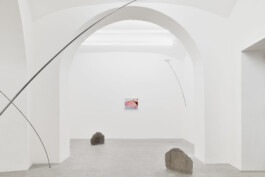
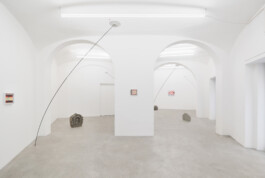
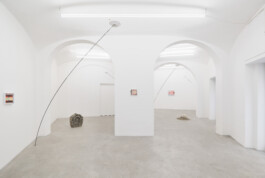
Common Ground is conceived as a space of coexistence. The project presents three recent bodies of work, each occupying the space autonomously while remaining open to dialogue. Sculpture, installation, and photography unfold in parallel, tracing distinct - at times converging - paths around questions related to structure, perception, and the relationship between natural and constructed systems.
In different ways, the practices of Angelino, Barile, and Canto engage with the tension between order and unpredictability, between the human impulse to define and the inherent complexity of observed phenomena. Through material processes, spatial interventions, and investigations into image-making, their works articulate a continuous negotiation between control and contingency - a way of inhabiting, rather than resolving, this dynamic.
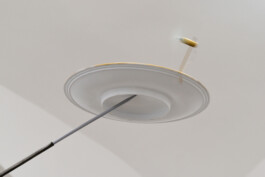
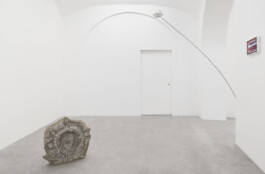
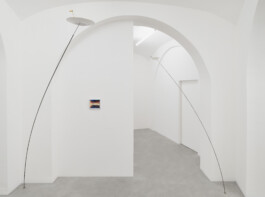
For the occasion, José Angelino presents a kinetic installation entitled Bisogna immaginare Sisifo felice (One Must Imagine Sisyphus Happy), composed of suspended discs rotating in delicate balance on slender metal rods, animated by the continuous airflow of a model-aircraft fan. The work originates from a reflection on the myth of Sisyphus — condemned to endlessly push a boulder to the summit of a mountain, only for it to fall back each time — reinterpreted through the thought of Albert Camus. In this reading, Sisyphus becomes not only an allegory of punishment, but also a figure of contemporary existence: a condition suspended between repetition, balance, and endurance, shaped by reiterated actions whose meaning lies not in their completion, but in their persistence.
As in Camus’ philosophy, Bisogna immaginare Sisifo felice (One Must Imagine Sisyphus Happy) locates meaning not in the attainment of an end, but in inhabiting movement itself. The installation does not stage failure; rather, it evokes an existential condition in which precariousness and equilibrium coincide and sustain one another.
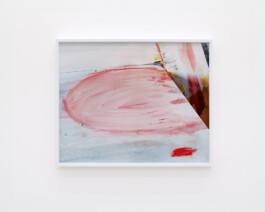
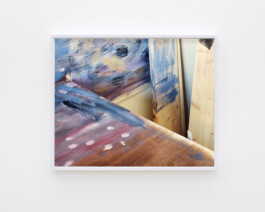
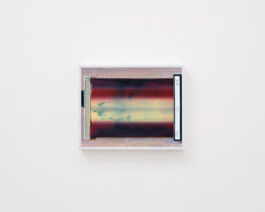
Fabio Barile premieres a new body of work developed through an extended process of experimentation, investigating the relationship between photography and painting through the use of the large-format camera — a central tool within his practice. By imposing an inverted vision of reality, the device initiates a gradual process of abstraction. The large-format camera introduces an expanded temporality and demands a deeply deliberate mode of working, shifting attention away from the instantaneous act of capture toward the construction of vision itself. Within this condition, subjects tend to dissolve into formal configurations, and the image emerges less as the registration of a moment than as the outcome of a process.
The research unfolds along two trajectories. The first focuses on the dark slide of the film holder, isolating the gesture of its withdrawal — the action that exposes the film to light — and removing it from its purely technical function. One of the most delicate moments in large-format photographic practice is thus reinterpreted in painterly terms: movement itself generates the image, while the photographer’s physical gesture becomes an integral component of the work.
The second trajectory approaches the studio backdrop as an active surface and a site for image construction. Traditionally conceived as a neutral ground against which subjects emerge, the backdrop here becomes an operative field — a space of intervention and visual articulation. Through this shift, space ceases to function merely as support and instead becomes a compositional structure, while the boundaries between background, painterly gesture, and photographic image progressively dissolve.
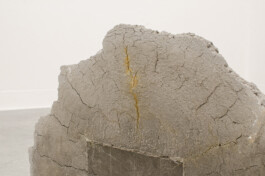
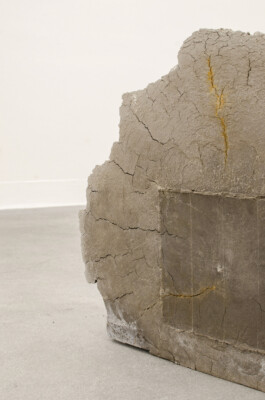
Stefano Canto further expands the research developed in his recent solo exhibition Dream of Stone, deepening a dialogue between the ephemeral and the permanent through sculptural processes that investigate the transformation and resistance of matter.
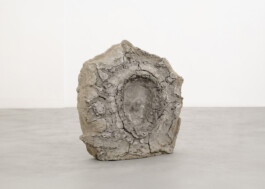
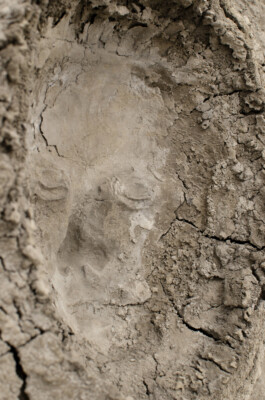
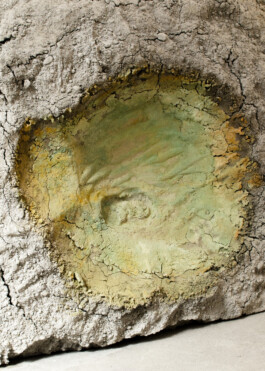
This new series, entitled Cloacina, emerges from subterranean Rome: an invisible city stretching beneath our feet, composed of conduits, cavities, traces, and sedimentations. The sewer system and the rising damp permeating the city — and consequently the gallery’s existing flooring — become the point of departure for a new body of sculptures. The works establish a dialogue between a submerged, imaginary dimension and one that is concrete, organic, and terrestrial: two halves interpenetrating until they merge into a single body.
Across dunes of cement dust, suspended in an intermediate state, lie imaginary figures that take shape through polychrome sculptures made of ice, oxides, and pigments. As the ice melts, it triggers a reaction with the underlying material, which gradually solidifies and mineralizes into a kind of fossil in formation, capable of retaining the traces of the face that once passed through it.
Within an equilibrium only partially governed by the artist, opposing states coexist: presence and absence, solidification and dissolution, artifice and natural process, emptiness and fullness — held in continuous tension between differing temporalities.
By bringing together three individual trajectories, the project outlines a broader perspective on the gallery’s commitment to supporting and consolidating artistic practices over time. Matèria positions itself in dialogue with the artists it represents and with the context it inhabits; it opens to different formats and to the possibility of working in public space through its Vitrine and Luci di via projects, challenging the format and space of the traditional gallery and defining its identity as an interlocutor for the artists with whom it collaborates, actively engaged in building long-term research.
The exhibition thus marks the beginning of a conversation; a dialogue that originates within the shared space of the gallery and extends outward, inviting further exchanges and developments. It is therefore both a presentation and a proposition: a first chapter in an encounter that the gallery intends to cultivate with its artists in the future.